
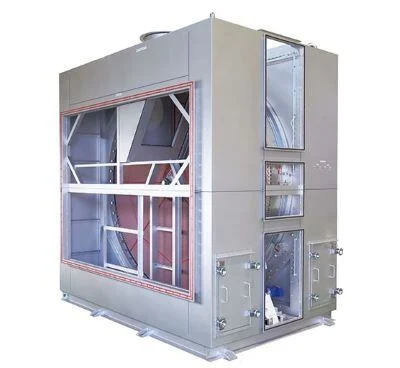
VOC Rotary Concentrator Systems (RCS)
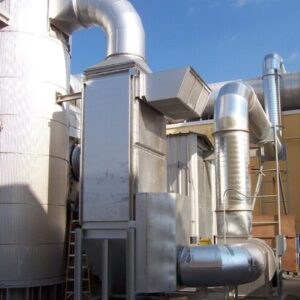
VOC Rotary Concentrator Systems (RCS) are designed to handle large volumes of air containing very low concentrations of volatile organic compounds (VOCs). These systems adsorb the organic materials onto a zeolite adsorbent medium contained in a continuously rotating disc or “rotor” (typically 2–6 revolutions per hour).
The primary advantage of using a VOC concentrator is reduced fuel consumption—particularly in large process exhaust flows with dilute VOC concentrations (generally below 500 ppmv).
How a VOC Concentrator Works
The rotor is divided into three sectors: Adsorption, Desorption, and Cooling.
Adsorption Sector
VOC-laden air passes through the adsorption sector (approximately 84% of the rotor’s media), where VOCs are removed from the process stream and adsorbed onto the zeolite honeycomb media. The cleaned process exhaust is then released to the atmosphere.
Desorption Sector
As the rotor rotates, the VOC-laden media enters the desorption sector (about 8% of the media). A smaller, heated gas stream (typically 5–20% of the process flow, most commonly 10%) passes through the media, releasing the concentrated VOCs. This concentrated desorption flow is directed to a thermal oxidizer (recuperative or regenerative) for destruction. Desorption temperatures usually range from 350°F to 400°F; higher temperatures can be used for VOCs with higher boiling points with equipment modifications.
Cooling Sector
Following desorption, the media enters the cooling sector (approximately 8% of the rotor). A portion of the process exhaust (5–20%) cools the zeolite media to improve adsorption efficiency when the rotor cycles back to the adsorption sector. The warmed cooling air is then heated to desorption temperature—using either oxidizer heat (via heat exchanger) or a separate desorption heater—and reused in the desorption sector.
Air Volume Capacity
Each rotary concentrator module can process gas flow rates from approximately 7,000 SCFM to over 90,000 SCFM, depending on process conditions. For larger flows, multiple modules can be combined into a complete abatement system.
Removal Efficiency (DRE)
Rotor concentrator removal efficiency depends on factors such as process exhaust temperature, humidity, VOC composition, and performance requirements. Typical efficiencies range from 95% to 97%, and in some cases up to 99%.
Overall VOC destruction efficiency is calculated by multiplying the rotor concentrator removal efficiency by the oxidizer destruction efficiency. For example: 95% concentrator efficiency × 98% RTO efficiency = 93.1% overall DRE.
Typical VOC Concentrator Applications
Processes with large air volumes and low VOC loadings are ideal for rotary concentrator systems combined with an oxidizer. Common applications include:
- Automotive paint booths
- Composite manufacturing
- Paint finishing systems
- Metal decorating
- Semiconductor fabrication
- Steel furniture paint booths
- Wood furniture paint booths
Other applications may also be suitable after evaluation by Catalytic Products International (CPI).
CPI offers complete system integration, including concentrator rotors, oxidizers, and controls, tailored to your specific process requirements.
评价
目前还没有评价