
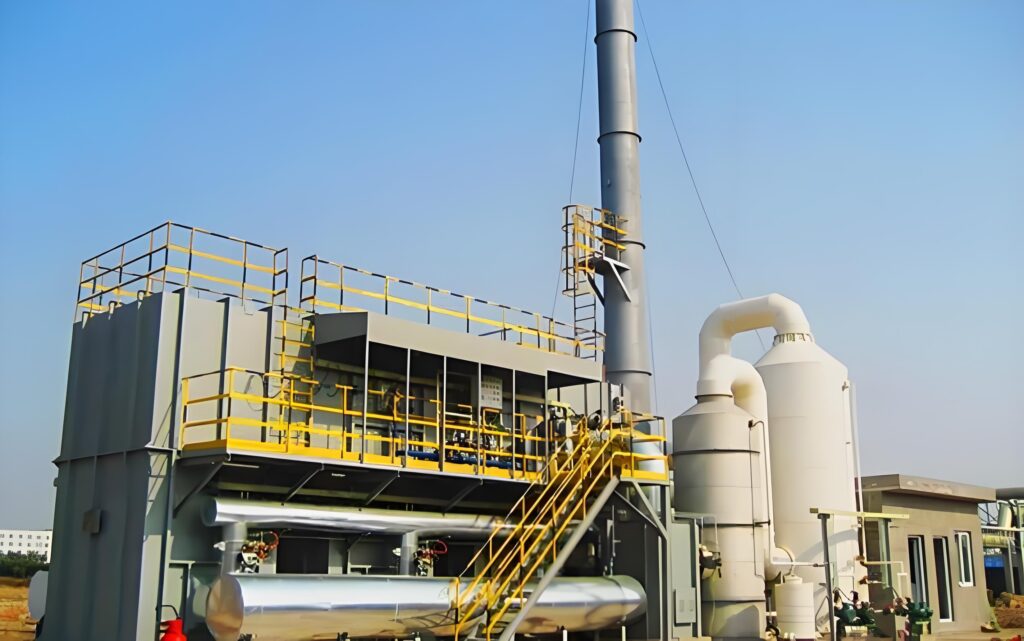
Beyond Compliance: Why RTO Technology is the Strategic Choice for Modern VOC Abatement
In today’s industrial climate, “meeting standards” is just the baseline. For plant managers and environmental engineers, the real challenge is finding a balance between rigorous emission control and the rising costs of energy. This is where Regenerative Thermal Oxidizer (RTO) technology shifts from a regulatory necessity to a strategic asset. By focusing on high-efficiency destruction and maximum heat recovery, systems like the Regenerative Thermal Oxidizer (RTO) are redefining what sustainable manufacturing looks like.
The Reality of VOC Treatment: Efficiency vs. Operating Costs
The core of any RTO Equipment is its ability to handle large volumes of air with relatively low concentrations of solvents. Unlike traditional thermal oxidizers that burn fuel constantly, an RTO uses a regenerative process. It captures the heat from the exhaust and uses it to preheat the incoming dirty air. When we talk about 95% Thermal Energy Recovery (TER), we’re talking about a massive reduction in your monthly gas bill.
From a technical perspective, the magic happens in the ceramic media beds. These beds act as a thermal battery. As the hot, cleaned air leaves the combustion chamber, it “charges” the ceramic media. When the valves switch, the incoming cold air draws that stored heat back out. In many cases, if your VOC concentration is high enough, the system becomes autothermal—meaning it sustains its own temperature without using the burner at all.
Solving the “High Volume, Low Concentration” Puzzle
One of the biggest mistakes in system design is oversized equipment. If you are running a high-volume line with low VOC levels (like in automotive painting or semiconductor labs), a standard RTO can be overkill. This is where a Rotary Concentrator + RTO combo changes the game.

By using a zeolite rotor to concentrate the pollutants first, you can treat the same amount of air with a much smaller, more efficient RTO. It’s about being smart with the physics of the process—concentrating the energy so you don’t waste it heating up empty air.
Key Technical Benchmarks for Procurement
When evaluating your next system, keep these 15 SEO-critical terms and performance metrics in mind:
- Regenerative Thermal Oxidizer: The core technology for high-volume VOCs.
- VOC Abatement System: Integrated solutions for air quality.
- Thermal Oxidation Technology: The process of high-temp destruction.
- Air Pollution Control Equipment: Broad category for compliance.
- Ceramic Heat Exchange Media: The “battery” of the RTO.
- Destruction Removal Efficiency (DRE): Target 99%+.
- Zeolite Rotor Concentrator: For low-concentration streams.
- Industrial Emission Compliance: Meeting EPA and local codes.
- Energy Recovery Solutions: Reducing OPEX through heat capture.
- Hazardous Air Pollutants (HAPs): The specific targets for destruction.
- Environmental Regulatory Standards: The “why” behind the investment.
- Three-Bed RTO Design: Best for zero-leakage and high DRE.
- Rotary Valve RTO: Compact and continuous flow design.
- Thermal Energy Recovery (TER): The efficiency metric that matters.
- VOC Destruction Efficiency: The final proof of performance.
For real-world examples of these systems in action, check our latest Industry News updates.
FAQ: What Engineers Actually Ask Us
1. How do we prevent the ceramic media from plugging?
Particulates are the enemy. We always recommend high-efficiency pre-filtration. If your process creates “sticky” residue, we look at bake-out cycles or specific media geometries that are easier to clean.
2. What happens to the system during a production downtime?
Most modern RTOs have an “Idle Mode.” The system maintains a lower temperature to save fuel while staying ready to ramp up quickly when production resumes.
3. Can we recover heat for other parts of the plant?
Absolutely. Beyond preheating the inlet air, we can install secondary heat exchangers to provide hot water or steam for your facility’s other processes.
4. Is a Three-Bed RTO worth the extra cost over a Two-Bed?
If your local regulations require >99% DRE, yes. The third bed eliminates the “puff” of untreated gas that happens during valve switching in two-bed systems.
5. How does moisture in the exhaust affect efficiency?
High humidity requires more energy to heat up. However, using hydrophobic zeolite in the concentrator phase can help manage moisture-rich streams effectively.
6. What is the typical maintenance schedule?
Quarterly sensor calibrations and valve inspections are standard. A full internal media inspection is usually done annually during a planned shutdown.
7. How do PLC controls help with compliance?
The PLC logs combustion temperatures and valve timing. This data is your “proof” for environmental auditors that the system was operating within parameters 24/7.
8. Can an RTO be moved if we relocate our plant?
Yes, most RTOs are modular. While the foundation and ducting are fixed, the main chambers and valve skid can be decommissioned and reinstalled at a new site.
Need a technical deep-dive into your specific exhaust profile? Contact Noxon Global today for a detailed engineering consultation.