Brief Introduction to Waste Gas Treatment in the Pharmaceutical Industry
The waste gas from the pharmaceutical industry has complex components, including benzene, toluene, ethanol, ethyl acetate, hydrogen chloride, etc. Among them, benzene rings and halogens tend to generate dioxins at around 400℃. Dioxins are highly stable substances with high melting points, are extremely insoluble in water, and are colorless, odorless and fat-soluble. As a result, they can easily accumulate in organisms and cause serious harm to human health. The generation of dioxins and the corrosion caused by acidic gases are the key characteristics that distinguish the pharmaceutical industry from other industries.
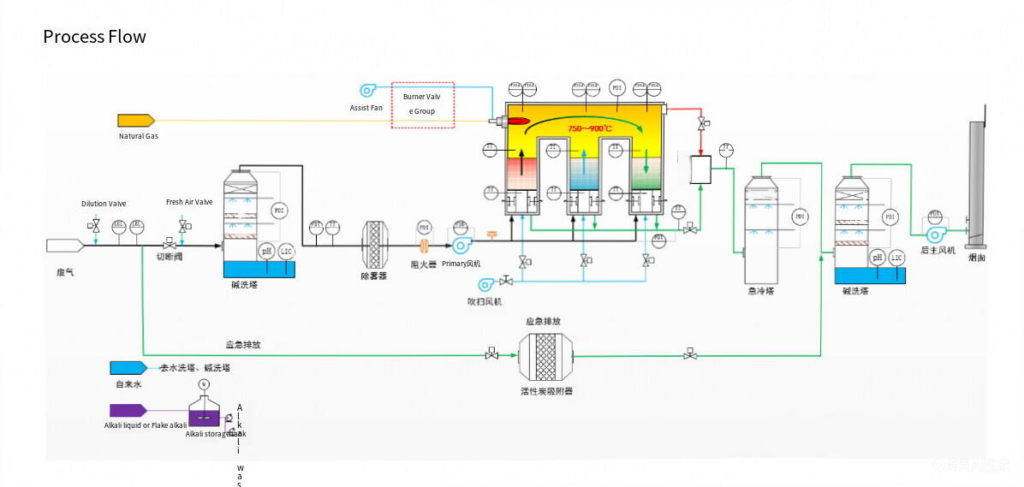
The waste gas is characterized by small air volume and medium concentration, most of which is organic waste gas with a portion of acidic gases. A reasonable treatment process is: Scrubbing + RTO + Scrubbing.
Typical Waste Gas Treatment Process in the Pharmaceutical Industry
Operating Conditions
Project Name: Waste Gas Treatment
Waste Gas Source: Reactor Waste Gas
Waste Gas Components: Toluene, Dichloromethane, Chlorobenzene, Non-methane Total Hydrocarbons (NMHC)
Waste Gas Concentration: 4000 mg/m³
Waste Gas Volume: 10000 Nm³/h
Inlet Temperature: 30℃
Operating Time: 24 hours per day, 7 days a week
Treatment Solution
Treatment Process: Pre-scrubbing + 3-RTO + Alkaline Scrubbing
Treatment Air Volume: 10000 Nm³/h
Incineration Temperature: 850℃
Burner Power: 200,000 Kcal/h (Natural Gas)
Total Installed Electrical Power: 50 kW
RTO Purification Efficiency: 99.5%
Emission Standard: Emission Standard of Air Pollutants for Pharmaceutical Industry – GB 37823-2019