
Details of Waste Gas Treatment in the Coating Industry
Coating / spraying refers to the application of a protective or decorative layer onto the surfaces of metallic and non-metallic materials, serving as the most fundamental technical method for surface protection and decoration of products.
The coating process can be simply summarized as: pretreatment → spraying → drying or curing. Pretreatment generally includes degreasing, derusting, and passivation (phosphating).
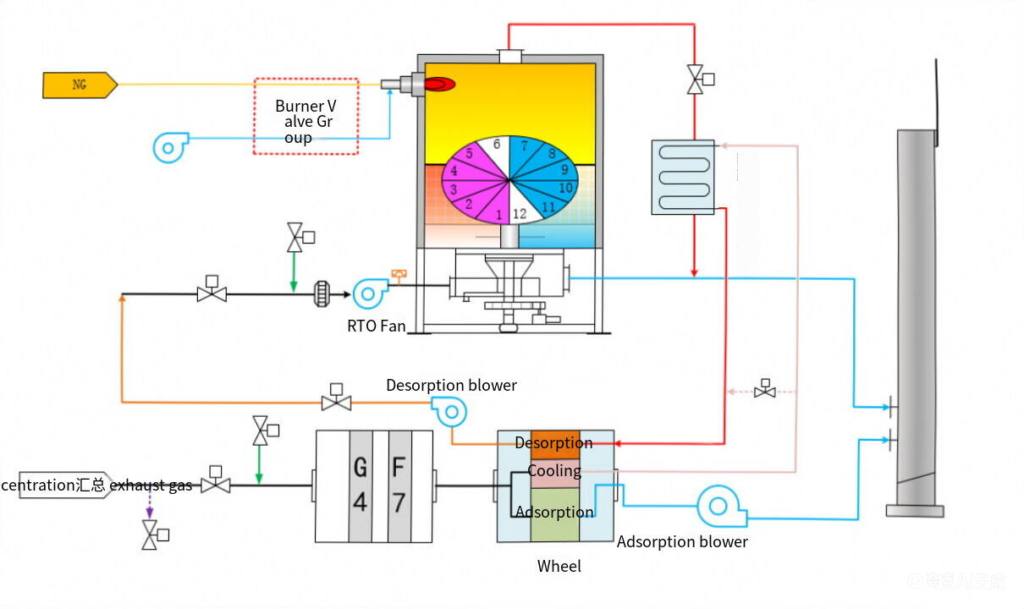
Based on the characteristics of waste gas generated in the coating industry, for coating waste gas with large air volume, low concentration, complex components and no recovery value, the preferred treatment method is a concentration rotor combined with thermal oxidation.
Typical Waste Gas Treatment Solutions for the Coating Industry
Operating Conditions
Project Name: Spraying Waste Gas Treatment
Waste Gas Source: Waste gas generated from paint spraying
Waste Gas Components: Toluene, Xylene, Non-methane Total Hydrocarbons (NMHC)
Waste Gas Concentration: 200 mg/m³
Waste Gas Volume: 60000 Nm³/h
Inlet Temperature: 20℃
Operating Time: 16 hours per day, 7 days a week
Treatment Solution
Treatment Process: 2950-V40 Concentrator Rotor + RV05 Rotary RTO
Treatment Air Volume: 60000 Nm³/h
Oxidation Temperature: 800℃
Burner Power: 300,000 Kcal/h (Natural Gas)
Total Installed Electrical Power: 70 kW
Rotor Purification Efficiency: 92%
RTO Purification Efficiency: 99%
Emission Standard: Emission Standard of Air Pollutants for Industrial Coating Processes – DB33 2146-2018